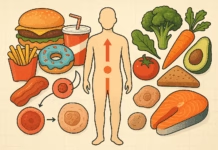

Understanding the best weight loss program, the best way to lose weight, and the most effective approach to reduce belly fat sustainably
Introduction
In recent decades, weight loss programs have become one of the most researched and discussed topics in health science. With rising rates of obesity and metabolic disease worldwide, the question is no longer whether people want to lose weight, but how to do it safely, effectively, and sustainably.
Many individuals search for the best weight loss program, hoping to find a solution that works without extreme restriction or short-lived results. Scientific evidence increasingly shows that long-term success depends less on rigid diets and more on consistent behavioral, physiological, and psychological adaptations.
This article explores what science says about effective weight loss programs, the best way to lose weight, and why understanding metabolism, movement, and habits is essential for reducing body fat—especially abdominal fat.

What Defines Effective Weight Loss Programs?
Scientifically validated weight loss programs share several core characteristics. They prioritize gradual energy balance, preserve lean muscle mass, and support metabolic health rather than forcing rapid weight loss.
Research consistently shows that programs focusing on behavior change—such as daily movement, improved food quality, and stress management—lead to more sustainable outcomes than extreme calorie restriction. This explains why no single diet can be labeled as the universal best weight loss program.
Instead, effective programs adapt to individual lifestyles, allowing people to lose weight while maintaining physical and mental well-being.
The Best Way to Lose Weight According to Science
Contrary to popular belief, the best way to lose weight is not found in drastic diets. Studies demonstrate that moderate calorie control combined with regular physical activity produces better long-term results.
Exercise improves insulin sensitivity, increases energy expenditure, and supports hormonal balance. When combined with nutrient-dense foods, this approach allows the body to reduce fat stores without triggering metabolic slowdown.
This balanced strategy is consistently recommended by health organizations as the safest and most effective way to lose weight over time.
Why Belly Fat Requires a Different Approach
Many people specifically search for the best way to lose belly fat, and science confirms that abdominal fat behaves differently from fat stored elsewhere. Visceral fat is more metabolically active and strongly influenced by hormones such as cortisol and insulin.
Chronic stress, poor sleep, and inactivity increase belly fat accumulation even when calorie intake is controlled. This is why effective weight loss programs emphasize stress management, sleep quality, and low-impact physical activity.
Walking, resistance training, and interval-based exercise have all been shown to reduce visceral fat when practiced consistently.
Best Weight Loss Program Is Not One-Size-Fits-All
From a scientific perspective, the best weight loss program is one that can be maintained. Programs that demand extreme effort or restriction often fail because they conflict with human behavior and physiology.
Research shows that people who adopt flexible routines—such as choosing enjoyable activities and realistic eating patterns—are more likely to maintain weight loss. This adaptability is crucial for long-term success.
The goal is not perfection, but sustainability. Programs that respect individual differences consistently outperform rigid plans.
The Role of Metabolism and Muscle Mass
Metabolism plays a central role in the ability to lose weight. Muscle tissue is metabolically active, meaning it burns more calories at rest than fat tissue.
Scientific studies show that preserving or increasing muscle mass through resistance training improves metabolic efficiency. This is why modern weight loss programs increasingly include strength training alongside cardiovascular activity.
A healthy metabolism supports fat loss while reducing the risk of weight regain.
Psychological Factors in Weight Loss
Weight loss is not purely physical. Psychological factors such as motivation, stress, and emotional regulation significantly influence outcomes.
Evidence suggests that individuals who develop positive relationships with food and exercise experience better long-term results. This supports the idea that the best way to lose weight includes mental resilience and habit formation.
Mindful eating, goal setting, and routine building are now considered essential components of effective weight loss programs.
Scientific Evidence and References
The following peer-reviewed sources support the strategies discussed in this article:
National Center for Biotechnology Information (NCBI)
https://www.ncbi.nlm.nih.gov/pmc/articles/PMC5764193/PubMed – Long-term weight loss strategies
https://pubmed.ncbi.nlm.nih.gov/30255333/World Health Organization – Obesity and weight management
https://www.who.int/news-room/fact-sheets/detail/obesity-and-overweightHarvard T.H. Chan School of Public Health – Weight management
https://www.hsph.harvard.edu/obesity-prevention-source/
Conclusion
Science shows that successful weight loss programs are built on consistency, not extremes. The best way to lose weight involves gradual lifestyle changes that support metabolism, mental health, and physical activity.
There is no universal formula for the best weight loss program, but evidence strongly supports approaches that integrate movement, nutrition quality, and stress control. When these elements align, it becomes possible to lose weight, reduce belly fat, and maintain results long term.
Ultimately, the most effective program is the one that fits your life—because sustainability is the true foundation of lasting weight loss.